‘Science Says’ Sunday – COVID-19 and Socioeconomic status: A lesson

Image may contain: 4 people, including Michael Frymark and Bertha Hidalgo, people standing

From my family to yours, a very Happy Easter. Definitely counting our blessings this year, for health, finances, and all other aspects of our lives. Praying for strength and comfort for those who may be experiencing a less than happy Easter Sunday this year. 

When I began to cover COVID-19 back in January, I started to worry about the implications this novel coronavirus had for our health, our healthcare system and infrastructure, but also what it meant for the financial stability of our immediate and extended family. Would our jobs be at stake? Would everyone be taken care of? Was our money protected in case this was a ‘worst case scenario’ situation? Would my husband and I be able to carry our immediate family through safely and financially through this crisis?

Money matters are a taboo subject. We don’t like to talk about how much we make, how much we should be saving, and many of us don’t have much finance training, unless we’ve sought it out or inherited generational knowledge. Not having had the latter, I’ve made the former my priority. I’ve made it my mission to learn and talk to money whenever I can, but especially when I think it will make a difference for others. Hence the motivation for today’s post.

Science says that socioeconomic status – or our social standing, often measured as a combination of education, income and occupation – is closely tied to health outcomes and health disparities. It is one of the most prominent social determinants of health. As a health disparities researcher, first and foremost, I am here to tell you that if no one has told you to think about your wealth and income security during this pandemic, you absolutely should think about doing so. It was shocking to me to hear that despite the slowdown of Amazon shipping, and no in-store shopping, sales on social media were soaring for affiliate sales. SOARING was the exact word used. Who were all these people shopping, I thought? Can they afford to shop even though their jobs might be at risk? On the other hand, I thought, perhaps they are the lucky ones. But do they know that now is not the time to shop anyway??

I have personally taken a very conservative financial approach with our money since we went into quarantine a month ago. I’m used to re-selling all my items once I’m done using them, but as I started to see more and more stories about job losses (>10 million people have filed for unemployment), and people failing to adhere to social distancing recommendations (more people likely to get sick and die), it occurred to me, liquid money and assets are what matters most in times like these. For that matter, all the clothes, shoes, etc, that I own, do not translate into wealth if there is no one who can buy them from me! My husband and I came out of the 2008 housing crash unscathed, but there are many others who did not. In many ways, this pandemic is far worse than that housing crash, so how the markets will fare remains to be seen. Best be prepared for that worst case scenario, I thought.

So, I called upon a friend who knows more about finances than I do, to walk you through money matters during a pandemic. Why? Because in order to ensure positive health outcomes in the future, you have to secure yourself financially now. We have to narrow that inequality gap, and becoming financially savvy is one way you will be able to accomplish that. I wish I had learned some of these things when I was younger, so I’m trying to share this now with you, so that you can start off earlier than me. 🙂

Below is a post from Lauren Pearson, founder of The Wealth Edit. Her blog brings you free and paid-course content to make you financially savvy. One blog post in particular “Coronavirus and Market Volatility” really struck a chord with what I was observing as a finance novice, and thought, ‘I bet my readers would love to hear from someone like her during this time’. So with that, I bring you her wisdom, during this time of COVID-19 craziness.

Money matters during a Pandemic

We are all adjusting to a new normal – our kids are home for many of us, our spouses are home, we have a new “office,” and we are worried about our public and individual health. So how are we feeling about our money?

Last week I read that for some of us, this pandemic is like a sprinkle, and for some of us this is like a hurricane. Some have lost their jobs, some have had to lay off employees, and for the blessed few, very little is different.

If you are like me, my family is spending money on food in ways we were not before. We were big on take out, and now we cook nearly every meal. Even though I am surprised by our grocery bill, I still believe in this category we are probably saving more than we were before, which is a good thing. Add in babysitters for date nights or evening obligations, we may be feeling like our pockets are more full.

What I would like you to do is to think strategically about your money. Right now. As women, we are taught that talking about money is taboo.  What I propose to you is this doesn’t matter. Not in a pandemic. It is our responsibility to be good with money, and to educate ourselves quickly. This cultural taboo is bad for women, and puts us at a disadvantage.

Yes, I am bombarded now on Instagram with sales from my favorite stores. Tempting? Yes. Important? No. What is important is to reframe your thinking around spending. Think about the decisions you are making for the health of your family. You are more than likely social distancing, only going to “essential” stores for purchases. Think about your finances through this same lens. What is essential? What purchases are really going to enhance your life? What items will last, and do you need them?

For my family, my kids’ camp will be canceled and our trip overseas will be canceled. This will mean I have five figures coming back into my bank account. It would be tempting to feel “overfunded” and to “splurge.”

At the Wealth Edit, our private membership community, we have created a Financial Minimalism course. I encourage everyone right now to practice Financial Minimalism. Why now? First, we have time to think about it. Second, we have been cut back (online sales being the great exception) to the essentials, so now we are forced to see what is truly essential. What a gift! Use this time to your advantage. What if instead of getting better things, or our economy, gets worse? I’m not suggesting it will, but I suggest you pressure test this theory within your household. We also do a personal recession audit (along with one for business, if you are a business owner). Having some arrows in your quiver as it relates to your finances will only be helpful.

Here are a few pandemic tips for you to follow to keep your wallet and your family safe:

  • Observe your spending and income. Write it all down. Just for a week. This is called cash flow (what is coming in, what is going out). I suggest writing everything you spend down twice. Once in the notes of your phone as you are spending, and then once at night in a notebook. This will be the first step towards conscious spending. Then write “E” next to the essential spending. This will come in handy to have this awareness, in the event you have to cut in the future.
  • Do you have money coming back to you? Stimulus, refunded trips, etc? Have a plan for this money. Of course I am going to encourage you to invest these dollars. First in an emergency fund, because everyone needs 3-6 months net income in cash for harder times. Then, if there is money left, invest it.
  • Don’t fall for the online sales! Just because your favorite brand is on sale for 40% off, doesn’t mean you need anything right now. I don’t shop online after 5 p.m. Create a plan for your spending, and execute on this. Don’t spend outside of this, if possible.
  • Know your financial stuff! It’s okay not to know anything right now, but find a venue to learn. If you want to try the Wealth Edit, we will give CIA readers $14 off their first month of membership. We would love to have you – use code CIA14 at checkout. I know, counterintuitive for me to ask you to spend, but the fact is this content, if consumed carefully, could save you significant money. Plus you get an amazing community of smart and interesting women who are also committed to talking about money.

Happy Easter,

Lauren

CEO, The Wealth Edit

I hope you will gain some food for thought from today’s post and find ways to build some of these tips into your own life. I know I will. I also leave you with Dr. Michael Marmot’s seminal post on income and health titled “The Influence Of Income On Health: Views Of An Epidemiologist“, should you need additional convincing that money matters indeed matter for health outcomes.

The Influence Of Income On Health: Views Of An Epidemiologist

Income is related to health in three ways: through the gross national product of countries, the income of individuals, and the income inequalities among rich nations and among geographic areas. A central question is the degree to which these associations reflect a causal association. If so, redistribution of income would improve health. This paper discusses two ways in which income could be causally related to health: through a direct effect on the material conditions necessary for biological survival, and through an effect on social participation and opportunity to control life circumstances. The fewer goods and services are provided publicly by the community, the more important individual income is for health. Under present U.S. circumstances, a policy of counteracting growing income inequalities through the tax and benefit system and of public provision appears justified.

‘Science Says’ Sunday – Covid-19 and Mental Health

wp-1586106119887537767444711899162.jpg

Last week, I chopped four inches off my hair. It isn’t something I would have never done under “normal” circumstances, say for example, in the absence of a pandemic.

Two-three weeks ago, I was working around the clock trying to adjust to my new normal. I was maybe sleeping 4-5 hours a day.

Three weeks ago, when I started working from home, I was on the verge of tears anytime I spoke with someone outside my home, but especially when talking to family and colleagues.

Experience in academia has taught me several things about how I handle stress, but most importantly, it has taught me that I internalize it so well, that I only realize I’m stressed once the stress has physically manifested and I feel unwell.

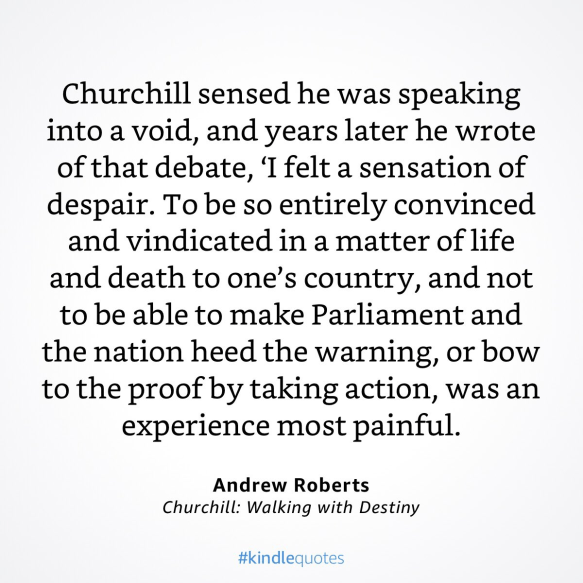
Once again, I had no idea I was feeling stressed. Actually, I was feeling panicked. Everyone says, “worry only about the things you can control”. Well, as an epidemiologist and science communicator, I felt like I had been sounding the alarm since January, maybe February! I felt and feel, like that is one part of this pandemic response that I am in control of. Yet, often, feel like I’m speaking to a select few only, and for something, speaking into a void.

winston quote.png

Still, I’ve persisted in my pursuit of science communication and continue to update anyone who will listen about scientific evidence arising about covid-19 and the virus that causes it. I post on Facebook, Twitter, Instagram, send via text…you name it. Give me a platform, and I will attempt to educate. Not to mention, regaining a semblance of normalcy as I work to continue my own scientific pursuits for work.

Still, not gonna lie, it’s exhausting. Especially when you see that people still don’t get it and/or simply fail to comply with #socialdistancing, for example.

Starting to realize that I was spiraling into a physical manifestation of stress/panic, I attempted to take a step back and reflect. Coincidentally, I read two things that put a lot into perspective:

  1. Guidelines for working during this pandemic” from the Association for Behavioral and Cognitive Therapies, shared by good friend and colleague Dr. Dori Pekmezi. 

No photo description available.

The first point was SO EYE OPENING. YES. I was, in fact, not just working from home. I was IN FACT, at home, during a crisis, trying to work. WOW.

Also, why was I on the verge of tears every time I joined a zoom call?? This tweet summarized the reason why:

Finally, as a natural introvert, I expected to transition into remote-work and social distancing pretty easily. But what I found myself experiencing was more profound than that. I found myself grieving. Then I read this article and it made made so much more sense:

People are feeling any number of things right now. Is it right to call some of what they’re feeling grief?

Kessler: Yes, and we’re feeling a number of different griefs. We feel the world has changed, and it has. We know this is temporary, but it doesn’t feel that way, and we realize things will be different. Just as going to the airport is forever different from how it was before 9/11, things will change and this is the point at which they changed. The loss of normalcy; the fear of economic toll; the loss of connection. This is hitting us and we’re grieving. Collectively. We are not used to this kind of collective grief in the air.

You said we’re feeling more than one kind of grief?

Yes, we’re also feeling anticipatory grief. Anticipatory grief is that feeling we get about what the future holds when we’re uncertain. Usually it centers on death. We feel it when someone gets a dire diagnosis or when we have the normal thought that we’ll lose a parent someday. Anticipatory grief is also more broadly imagined futures. There is a storm coming. There’s something bad out there. With a virus, this kind of grief is so confusing for people. Our primitive mind knows something bad is happening, but you can’t see it. This breaks our sense of safety. We’re feeling that loss of safety. I don’t think we’ve collectively lost our sense of general safety like this. Individually or as smaller groups, people have felt this. But all together, this is new. We are grieving on a micro and a macro level.

Screen Shot 2020-04-05 at 12.49.08 PM.png

Article linked, here.

Eventually, I left myself breakdown. Several times. I broke down in tears, all by myself, and let it all out. Sometimes, you have to break down in order to build yourself up again.

So what does this all mean and what am I to do??

So, if anything you have read in this post rings a bell, or if you identify with it in any way, you may be asking, well, how do I fix it. I started to wonder the same thing, and refer to the third section of the HBR article, which says:

Understanding the stages of grief is a start. But whenever I talk about the stages of grief, I have to remind people that the stages aren’t linear and may not happen in this order. It’s not a map but it provides some scaffolding for this unknown world. There’s denial, which we say a lot of early on: This virus won’t affect us. There’s anger: You’re making me stay home and taking away my activities. There’s bargaining: Okay, if I social distance for two weeks everything will be better, right? There’s sadness: I don’t know when this will end. And finally there’s acceptance. This is happening; I have to figure out how to proceed.

Acceptance, as you might imagine, is where the power lies. We find control in acceptance. I can wash my hands. I can keep a safe distance. I can learn how to work virtually.


But also, this article which spoke to one of the things I was worried about the most…my productivity.

Screen Shot 2020-04-05 at 1.14.35 PM.png

Linked here

Among the tips, the suggestion to “embrace a new normal”. In my mentoring, I always speak to the ability to be flexible, and how flexibility is many time, the key to success. Worrying about what was going to happen next, in the presence of uncertainty was wasted energy for me. Rather, focusing on what I knew what certain for at least another month (ie remote working), and findings ways to thrive and adapt, would be how I would move forward.

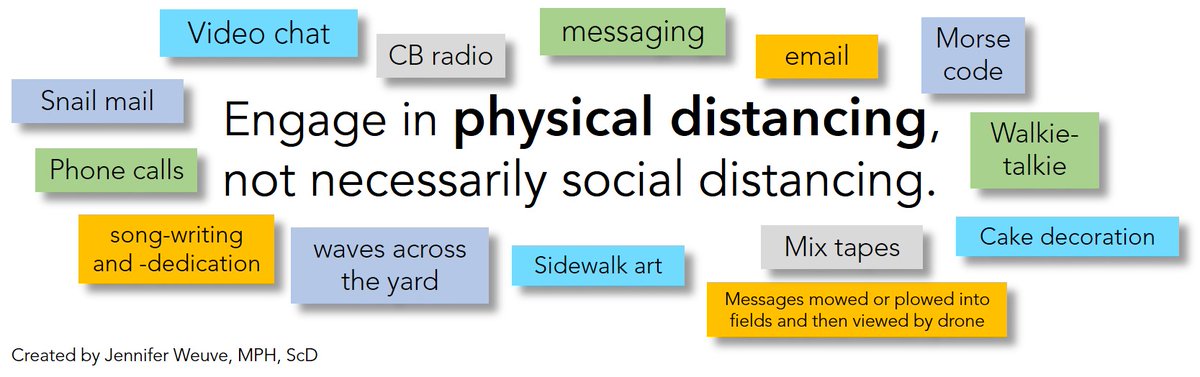
Thanks to friends, I quickly found ways to reconnect with friends and family I was no longer seeing on a regular basis. The House Party app and Facetime have been great ways to reconnect. We, as a family, take more bike rides than ever before. We make an effort to play outdoors at least an hour a day. Those are things we keep within our control. I’ve also reminded friends that social distancing DOES NOT MEAN SOCIAL ISOLATION. Make it a point to stay connected. Fellow epidemiologist and twitter colleague posted this recently, and provides suggestions for staying in touch with people.

Image


Everyone says, “worry only about what you can control”. Well, that has certainly been harder for me to do than people expect it to be. I am a worrier by nature. I worry about all the things, all the time. So what is working for me, is coping. The articles mentioned above, are things that are shifting my mindset and helping me cope.

Remember that stress is not good for your health. I know this well. If you are struggling with this, I highly encourage you to talk to someone about it. Here are some tips provided by my institution. I hope they are helpful for you:

“Despite the outbreak, it’s important to remember that life still goes on and that there are a number of strategies people can use to cope with this type of stress, said Laura Dreer, Ph.D., a clinical psychologist in the University of Alabama at Birmingham Department of Ophthalmology and Vision Sciences. “We know that people have a tremendous ability to flourish in light of what one might consider life-altering situations.”


Screen Shot 2020-04-05 at 2.10.40 PM.png

Article linked here


As I mentioned before, we are likely in this for at least a month longer, if not more. That means, at all costs, try to preserve your sanity, take care of yourself and your family first, in whatever ways that is possible. I know that many of my family and friends are considered essential workers, and for them, social distancing is not possible. I can’t imagine the stress that must be causing. For those who are affected financially by the covid-19 crisis, this HAS to be extremely stress and panic-inducing. If this applies to you, here’s a good article I found with resources that I hope can provide some answers.

Screen Shot 2020-04-05 at 2.16.51 PM.png

Article linked here

I end with a poem that is relevant to the topic of infectiousness, and something you can do from a distance. 🙂

Pin on Quotes to live by

‘Science Says’ Sunday – 5 facts about COVID-19 communication

wp-15855030404004232407826295907801.png

Last week, I shared a short Instagram TV video where I pleaded with my viewers/readers to please continue social distancing. In that time, I have given media interviews, participated on video podcasts like Communal Expressions, all with the same message: We must continue to practice social distancing to help flatten the curve.

A colleague of mine shared a Twitter thread by Vivek Murthy, titled “Five tried and true principles for communication during a public health crisis (these literally save lives). In it, he shared five principles that are crucial to communication during public health crises and they include:

  1. Be transparent and truthful
  2. Be consistent
  3. Over communicate
  4. Lead with scientists and science
  5. Be compassionate

In my communication on Chic in Academia, I have attempted to share messages about COVID-19, keeping all of the above in mind. What is disheartening is, hearing people continue to call this all a hoax; saying that flattening the curve and social distancing is an over reaction; discrediting the fact that scientists, physicians, health care workers, and so many others are working tirelessly to try and get this pandemic under control.

Last week, I shared information with articles providing evidence that :

While I recognize that not everyone I know reads my blog, or that everyone you know reads this blog, I do know that this messaging is not unique, and mirrors what a lot of experts are saying.

For what it’s worth, until we have (not listed in any particular order),:

1) COVID-19 tests for everyone

2) ventilators and beds for all critical ill patients

3) personal protective equipment for our friends on the front line (physicians/healthcare workers)

4) antibody tests

5) an effective drug treatment

6) a vaccine

7) accurate data (we still don’t know exactly what our denominator is!!)

8) accurate and consistent messaging about what we need to do to get a handle of this pandemic

we will continue to see known case and mortality numbers increase, especially if we don’t continue social distancing. Ensuring #1-8 above will help reduce the need for social distancing. At minimum, #1-6 would help provide answers for #7 and #8.

I have shared all the information we have to date. What we need now is some degree of ‘lever adjustment’ to move forward. In the short term, a high degree of social distancing is important because we need the other levers to rise or increase in order to reduce the lever or need for social distancing:

Screen Shot 2020-03-29 at 5.14.14 PM

Once we have a effective treatment, antibody tests to determine who has been sick and recovered, comprehensive testing, and everything our hospitals need to treat everyone who gets sick, then we can begin to scale back on significantly on social distancing efforts.

Screen Shot 2020-03-29 at 5.16.22 PM

NOTE: If you’re reading this and can help me make these figures interactive, please email me! bhidalgo@uab.edu

In the news this week, you may have heard that more masks are coming, that additional ventilators are being shipped to states, and that companies are developing tests to determine whether you are positive or have been previously infected. I’m excited to see what awaits us, but for now, social distancing is a must.

Because I haven’t been able to upload my own IGTV video, here’s one that Communal Expressions shared this week on their Facebook page where I answer a number of questions about what we do and don’t know about COVID-19:

Finally and most importantly, many of you continue to ask questions about the following topics, so here are some short answers:

  1. Can I continue to take Ibuprofen? YES. Here’s an article that tells you why you should not be quick to abandon current treatment you may be on.
  2. Can I wear a mask if I have one? If you have surgical or N95 masks at home, you should donate them to your local hospital because many hospitals DO NOT HAVE ANY. If you are making homemade masks, please also donate those to your local hospital until they can obtain more surgical and N95 masks. When are hospitals are fully stocked, then you can wear masks if you want to. If you are sick, you should be at home, and you can wear a mask to keep droplets from falling all over your house and infecting other people in your home.
  3. Can I pick up takeout, curbside meals, or get food delivered? Yes! Read about why it’s safe here.
  4. Can I self-treat if I think I have or have been diagnosed with COVID? NO. Read why here.
  5. Can I get re-infected with COVID-19 if I’ve already had it? Evidence suggests no. Good article describing why, here.
  6. Is the virus mutating? Yes, but here’s why it doesn’t appear to be a big problem.
  7. Should I worry about my risk for COVID-19 if I have a specific blood type? NO. Here’s why.
  8. I’m interested in COVID-19 projections for my state. Where can I find that information? Here’s a good resource!
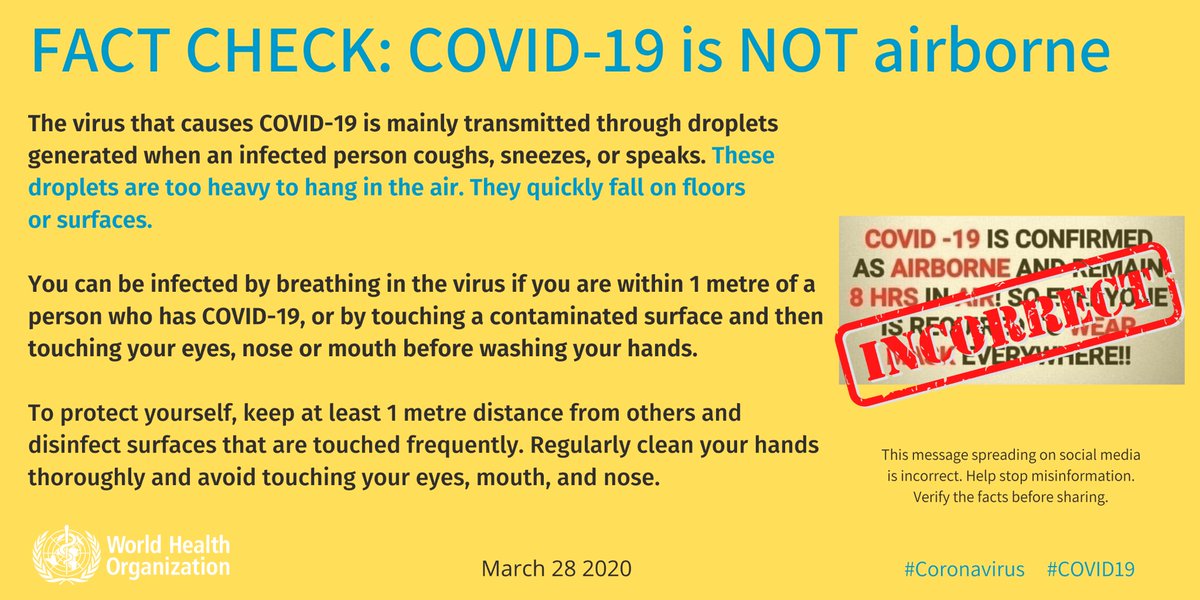
  9. Is the virus that causes COVID-19 airborne?! No. World Health Organization fact check, here. Note that aerosols ARE an issue in hospital settings during intubations, for example, so medical professionals do need to worry about the virus becoming aerosolized and need appropriate personal protection like face masks to prevent getting infected.Image
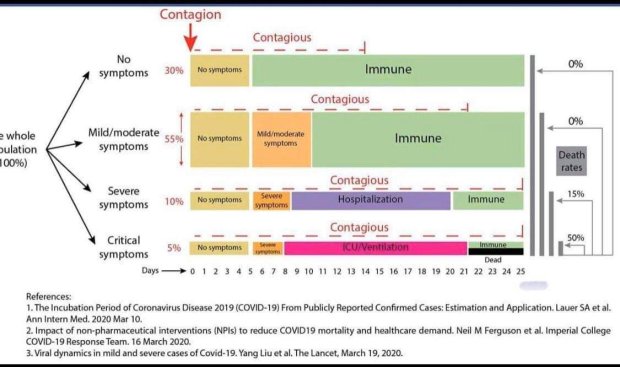
  10. Can I infect other people even if I am not symptomatic? YES. The evidence we have so far suggests that there is some asymptomatic transmission/infections happening. Here’s a figure that shows what the current evidence suggests:

wp-15855167150457702679418297645326.jpg

In short, whether you only get a little sick or super sick, the fact remains: YOU CAN MAKE OTHERS SICK during the period when you have ZERO TO NO symptoms. Until we can test everyone, and adjust the levers on the graphic shown above, please #stayhome and keep #socialdistancing to help #flattenthecurve.